

The best RV park for a long-term stay is not simply the one with the highest star rating or the lowest advertised monthly price. It is the park that fits your rig, budget, schedule, work or family needs, and written terms. A careful review should combine recent guest feedback with direct answers from the park.
This checklist is designed for travelers comparing extended-stay RV parks in Central Texas and elsewhere. Colinas RV Park is located at 446 Las Lomas Drive in Elgin, Texas, near the Austin area. Use the same questions whether you are considering Colinas or another park.
The Federal Trade Commission’s guide on how to evaluate online reviews recommends checking multiple sources, looking at how recent the reviews are, and watching for unusual bursts or patterns. A star average alone cannot tell you whether a site fits your equipment, whether a policy changed, or what a current quote includes.
Read a mix of recent positive, neutral, and negative reviews. Look for repeated details about communication, site condition, noise, utilities, and problem resolution. Then ask the park about the concerns that matter to your stay and request important answers in writing.
Provide the RV’s total length, height, slide configuration, power requirement, tow vehicle, and any second vehicle or trailer. Ask about the site’s usable dimensions, surface, slope, overhead clearance, approach turns, and parking arrangement. “Big-rig friendly” is not a measurement.
Confirm electrical service, water, and sewer for the specific site type you would reserve. Ask who handles an outage or connection problem and whether any equipment or adapter is your responsibility. Do not assume every site has the same configuration.
Request an itemized quote showing the base rate and any electricity, water, sewer, trash, internet, deposit, reservation, vehicle, pet, guest, or late-payment terms. Ask when a meter is read and how usage is calculated if electricity is billed separately. A low headline rate is not useful until the full recurring cost is clear.
Confirm the minimum or maximum stay, renewal process, occupancy limit, and notice required before departure. If you need the location for mail, school, voting, vehicle registration, or another residency-related purpose, ask the park and the appropriate authority; do not assume an RV reservation establishes residency or mailing eligibility.
Ask when payments are due, which methods are accepted, whether a deposit is refundable, what notice is required to cancel, and what happens if work dates or travel plans change. Keep the written reservation confirmation and policy version that applies to your stay.
Ask what connection the park currently provides and whether there are usage or equipment limits. If remote work is essential, test your own devices and carrier rather than relying on a speed promise. The FCC National Broadband Map can help identify reported provider coverage, but it does not guarantee performance at a particular site or inside an RV.
Confirm current laundry access, restroom or shower availability if needed, trash procedures, package delivery, mail handling, propane options, and emergency contacts. Ask whether any shared facility has limited hours or separate fees.
Request the complete current policy. Ask about pet number, size or breed rules, leashes, waste, visitors, additional vehicles, work trucks, trailers, generators, outdoor storage, and quiet hours. A general “pet friendly” label does not answer those details.
Confirm the arrival window, after-hours procedure, gate or access instructions, office or support hours, and the best contact if the assigned site is blocked or unsuitable. Review the route with the full rig in mind rather than depending only on the shortest navigation-app suggestion.
Check National Weather Service Austin/San Antonio for current forecasts and alerts and DriveTexas for reported road conditions. Ask the park about its severe-weather communication, drainage, freeze preparation, and utility-outage procedures. Recheck conditions before each trip because weather and road work change.
Map the route from the park address to the actual jobsite, medical provider, school, grocery store, or other recurring destination. Test the route at the time of day you expect to travel. Avoid a fixed commute promise; construction, traffic, weather, and the destination itself can change.
Notice whether answers are specific, consistent, and provided in writing when requested. Ask how maintenance and utility issues are reported, when staff or support is available, and what the escalation process is. Good communication before booking is useful evidence about how a long stay may be handled.
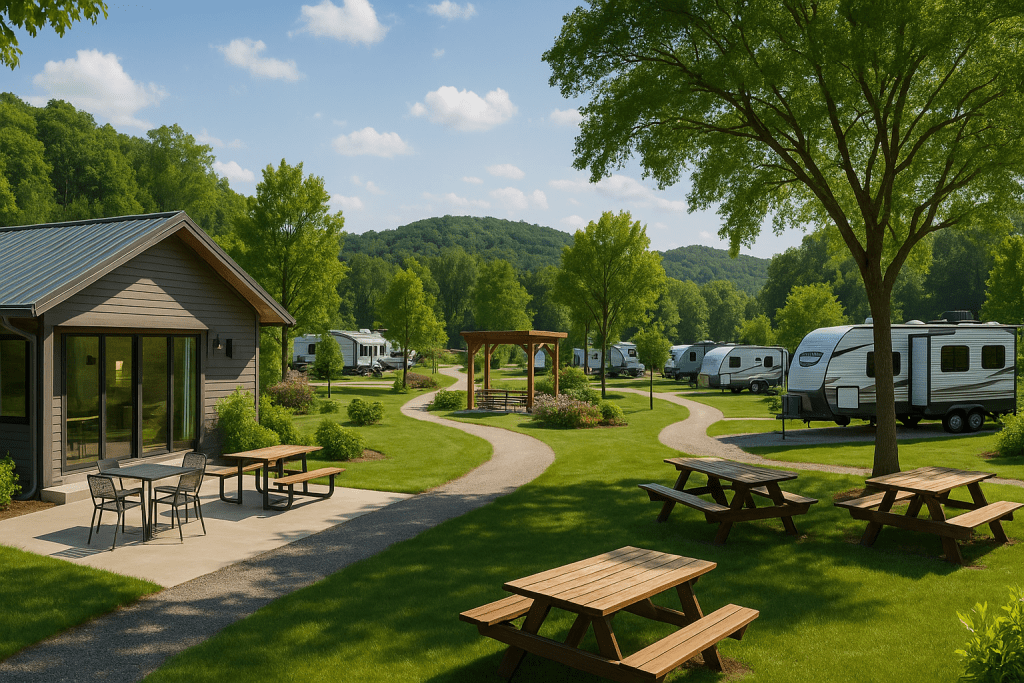
The Colinas website currently describes full-hookup sites, internet service, laundry facilities with a lounge area, a gated entrance, shaded surroundings, and dog-walking areas. Review the park’s current amenities and rates section, then confirm which features, costs, and policies apply to the site and dates you are considering.
For a side-by-side monthly-stay method, see the separate Austin-area monthly RV park comparison checklist. Travelers coming for a job assignment can also use the Elgin workforce-stay guide.
Before reserving, send your dates, RV and vehicle details, number of occupants, pets, work schedule if relevant, and any accessibility or connectivity requirements. Ask for the complete current quote and policies that apply to the proposed stay.
Check current Colinas RV Park availability on Campspot. Booking availability does not replace verification of site fit, total cost, utilities, policies, road conditions, or internet and cell performance.